
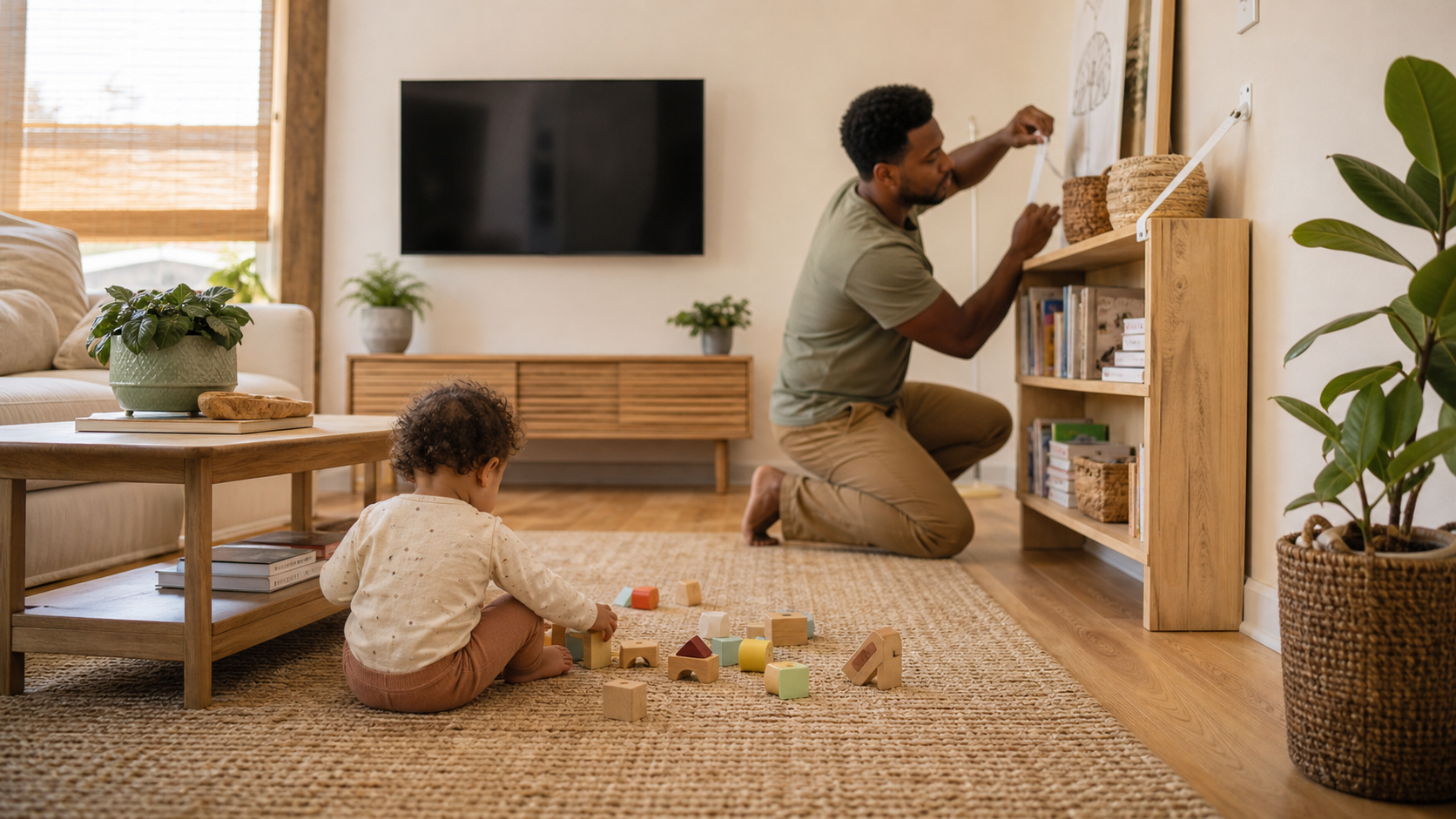
You do not need to turn your house into a padded showroom before your baby arrives. Most babies spend their first months lying exactly where you put them. Then one Tuesday afternoon they roll under the coffee table, find a cable you did not know existed, and make a beeline for the dog bowl. That is when childproofing stops feeling theoretical.
The useful way to do it is not "buy every safety gadget." It is to change the house as your child gains a new skill. Rolling changes the floor. Crawling changes every low cupboard. Climbing changes the whole room.
Start with the hazards your child can reach today. Put a note in your phone to walk through the house again whenever they learn something new.
The jobs worth doing before baby is mobile
Some fixes are easier when you are not trying to fit them around naps.
- Anchor dressers, bookcases and TVs that are not already secured. The U.S. Consumer Product Safety Commission warns that furniture, televisions and ranges can tip over when children climb, pull up or fall against them. Use the hardware made for the item and attach it to a solid wall point, not just drywall.
- Check windows now. Screens keep bugs out; they do not stop a child falling. Window guards or opening-control devices should still leave an escape route in case of fire.
- Replace looped or dangling blind cords with cordless coverings where you can. A tidy-looking cord can still be within reach of a child who has learnt to climb onto a sofa.
- Test smoke alarms and carbon-monoxide alarms. Decide where the family meets outside if there is a fire. It sounds dramatic until you try explaining it for the first time with a frightened child on your hip.
- Put the number for Poison Control somewhere obvious. In the U.S. it is 1-800-222-1222. If a child is unconscious, having a seizure or struggling to breathe, call emergency services instead.
If you are setting up a nursery, keep sleep separate from childproofing gadgets. A safe sleep space is simple: a firm, flat surface with no loose bedding, pillows or toys. Newborn care can feel overwhelming at first, but this part does not need expensive extras.
When your baby starts rolling and crawling
This is the stage where adults tend to protect the obvious things and miss the low, ordinary ones: a coin under the sofa, a charging cable, the remote control with its battery compartment hanging loose.
Get down on the floor and look from your baby's height. You are looking for anything they can swallow, pull down, chew, or reach while you are making a sandwich.
Move medicines, vitamins, cleaning products, alcohol, laundry pods and dishwasher tablets into a high locked cupboard. "Up high" is not the same as safe once a toddler drags over a chair. Keep products in their original containers too. A drink bottle is never a safe place to decant cleaning fluid.
Check the floor every evening if older children live in the house. Small toy parts, magnets, button batteries and coins travel. If you find a damaged toy or a remote with a loose battery cover, remove it until it is fixed.
Put covers on unused electrical outlets if they are loose or accessible, but do not rely on covers to supervise a curious child. Secure cords behind furniture or in cord covers, and keep chargers away from beds and cots.
The kitchen needs layers, not one magic latch
The kitchen is not off limits forever. You need it to be a place where your child can be near you without getting access to knives, heat or chemicals.
Put sharp tools, medicines and cleaning supplies behind a latch or lock. Turn pan handles inward when you cook. Keep hot drinks away from the table edge and do not hold a hot drink while carrying a baby. An oven lock can be useful, but it is the habit of checking what is within reach that matters more.
Do not leave a toddler alone in a high chair, even for the ten seconds it takes to answer the door. Use the harness every time. If they want to help, give them a safe job at the other end of the counter: washing strawberries in a bowl, tearing lettuce, or putting wooden spoons in a drawer.
Bathrooms, water and the things adults forget
Water is one of the few hazards where "I was only gone for a second" can have serious consequences. Empty the bath as soon as bath time is over. Keep toilet lids closed, and use a latch if your child is fascinated by flushing things. Buckets, mop pails and pet water bowls deserve the same attention.
Keep razors, cosmetics, cleaning products and medicines locked away. A child lock on the bathroom cabinet is useful, but medicine should still be stored high and out of sight. Children notice the bottle you reach for every morning.
Set your water heater to a safe temperature according to local guidance. Test bath water with your wrist before your child gets in. Their skin burns more easily than yours.
The climbing stage changes the rules again
The biggest shift is not walking. It is climbing.
The child who could not reach the counter last month may now be able to stand on a dining chair, open a drawer, and use it as a step. Re-check the room after every new trick. Move chairs away from counters and windows. Do not store tempting objects, such as the TV remote or a favourite snack, on top of a dresser they might try to scale.
Furniture anchors are still important even when the shelves look heavy. A determined toddler does not need to pull an entire bookcase over deliberately. They only need to use an open drawer as a ladder.
Gates help at the top and bottom of stairs, but choose hardware-mounted gates for the top of stairs. Pressure-mounted gates can be useful in doorways on the same level; they are not a substitute for a secure stair gate.
If your home was built before 1978
This is worth a separate check. Older homes may have lead-based paint, especially around windows, doors and other surfaces that rub or chip. CDC guidance says children under six are at the greatest risk from lead exposure, and many children have no obvious symptoms.
Do not sand, scrape or renovate peeling paint around young children without lead-safe precautions. Ask your child's clinician or local health department whether testing makes sense for your family. Keep children away from renovation areas, wet-clean dusty window sills and floors, and wash hands before meals.
The five-minute reset that keeps childproofing realistic
Once a week, do this before bed:
- Walk through the rooms your child uses most.
- Pick up anything small enough to swallow.
- Check that cabinet latches, gates and furniture anchors still work.
- Look for a new climbing route.
- Ask yourself what your child learned this week that they could not do last week.
That last question is the whole game. Childproofing is not one shopping trip. It is a moving target, because children are moving targets.
You will miss things sometimes. Every parent does. The goal is not a house where nothing can happen; it is a house where the predictable, serious hazards have been made much harder to reach.
For the next developmental changes to watch for, use our milestone tracker. If your toddler has turned exploration into a daily boundary battle, this guide to setting boundaries with a clingy toddler can help you stay calm without giving them the run of the house.